头条英文播报|US spin on virus's name condemned
来源:中国日报
US spin on virus's name condemned
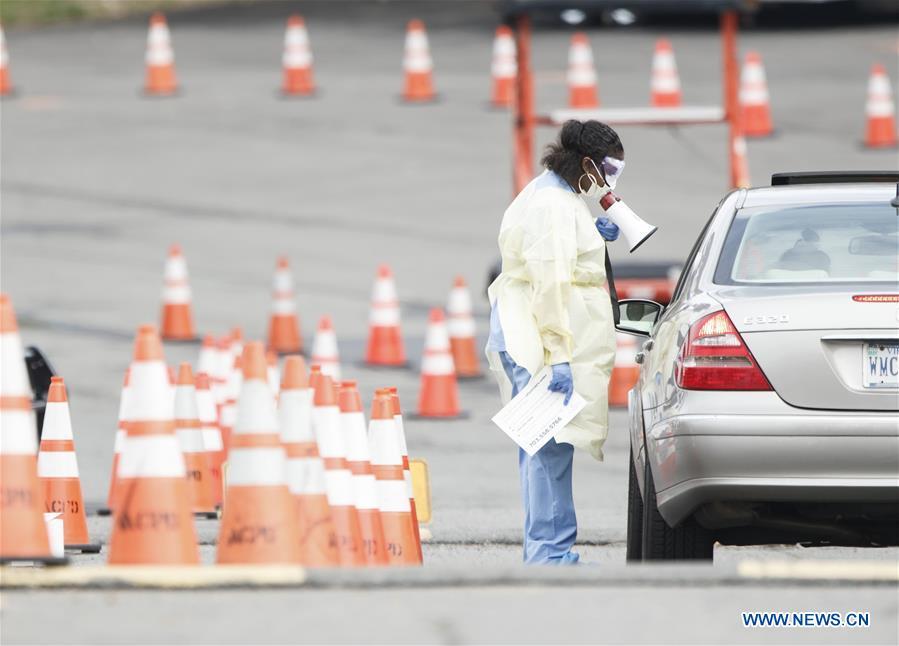
A health worker directs a driver at a drive-through COVID-19 testing location set up by the Virginia Hospital Center in Arlington, Virginia, the United States, on March 19, 2020. [Photo/Xinhua]
'We didn't call 2009 influenza pandemic 'North American flu',' WHO official says
Some US politicians attempting to politicize the novel coronavirus have come under fire as officials, scientists and experts on international relations warned that such stigmatization would undermine international solidarity in containing the pandemic.
The warning came after some senior US officials connected the virus with China. They include US President Donald Trump, who described the coronavirus as the "Chinese virus" on social media and a White House media briefing, although Director Robert Redfield of the US Centers for Disease Control and Prevention said using the word Chinese as a way to describe the coronavirus is wrong.
On Monday, Yang Jiechi, a member of the Political Bureau of the Communist Party of China Central Committee, told US Secretary of State Mike Pompeo that Beijing strongly opposes and condemns certain politicians' slanderous stigmatization of China as it fights the novel coronavirus pneumonia outbreak.
Yang, who is also director of the Office of the Foreign Affairs Commission of the CPC Central Committee, said any attempt by the US to discredit China will not succeed and any act that undermines the interests of the country will be resolutely fought by the Chinese side.
During telephone conversations with the foreign ministers of Singapore, Russia and the Netherlands as well as Indonesia's coordinating minister for maritime affairs and investment on Wednesday, State Councilor and Foreign Minister Wang Yi said that China strongly opposes labeling the virus with the name of a country as it is disgraceful, immoral and unfair.
Such a move will divide the international community, Wang said, adding that it does not help efforts to unite countries in the battle against the spread of the pandemic, nor will it contribute to the disease prevention and control efforts in the US.
The three foreign ministers also expressed their opposition to the stigmatization of China.
The World Health Organization gave the pneumonia caused by the novel coronavirus the generic name COVID-19 on Feb 11 to avoid stigmatizing a country or particular group, choosing a name that doesn't refer to a geographical location, animals, an individual or a group of people.
WHO officials have warned against calling COVID-19 the "Chinese virus", saying that it could lead to racial profiling.
At a media briefing on COVID-19 at the headquarters of the United Nations body on Wednesday, Mike Ryan, executive director of the WHO's health emergencies program, said: "It's really important that we be careful in the language we use."
"The pandemic of influenza in 2009 originated in North America, and we didn't call it the 'North American flu'," Ryan said. "So it's important that we have the same approach when it comes to other viruses."
"This is a time for solidarity, this is a time for facts, this is a time to move forward together, to fight this virus together. There is no blame in this," he said. "All we need now is to identify the things we need to do to move forward quickly, with speed and to avoid any indication of ethnic or other associations with this virus."
London Breed, the mayor of San Francisco, said references to the virus that causes COVID-19 as a "Chinese virus" are "offensive and counterproductive".
"There is never an excuse for xenophobia. Coronavirus is a global pandemic that is affecting all of us, and it requires all of us to listen to public health experts and respond together," Breed said in a statement.
Zhong Nanshan, the prominent Chinese expert on respiratory diseases, said at a news conference on Wednesday that although Wuhan, the hardest-hit Chinese city, first reported the outbreak, there is no evidence that the city is the source of the virus that caused COVID-19.
A lot more needs to be understood about COVID-19 and international cooperation is important in fields such as drug development, he said.
Scientists have discovered through clinical records and genetic tracing that the Huanan Seafood Market in Wuhan may not be the source of the virus after all, according to the journal Lancet and other follow-up studies.
The market might just serve as a jumping-off point where the virus emerged and began infecting a wider public, but who or what brought the virus to the market in the first place remained unknown, scientists noted.
The Foreign Ministry has reiterated on many occasions that China believes that the origin of the virus is a matter of science which requires a professional and science-based assessment.
Li Haidong, an international relations professor at China Foreign Affairs University, said that playing the blame game might help politicians divert public attention from their own lackluster response to the outbreak and alleviate social pressure in the short run, but people will eventually catch on.
"Those who are pointing fingers now will soon realize this pandemic is a common challenge that must be addressed through honest and constructive collaboration," Li said.
John Ross, former director of economic and business policy for the mayor of London, said in an article that through the determined fight against the virus, China created a window of opportunity of almost two months for the rest of the world before the coronavirus began to significantly spread outside the nation, but this time was wasted.
Instead of learning the positive lessons of China's ability to control the virus, the US government and the Western media engaged in anti-China propaganda, said Ross, a senior fellow at the Chongyang Institute for Financial Studies of Renmin University of China.
"The bitter truth is that people in the West now face a medical, human and economic disaster due in significant part to this anti-China propaganda," he added.
Find more audio news on the China Daily app.
【背景阅读】
煽动种族主义和歧视仇外贻害全球抗疫
新华社北京3月19日电今年以来,美国一些政客借新冠肺炎疫情大肆污名化攻击中国,一些美国媒体发表带有明显种族歧视意味的辱华文章,诋毁中国抗击疫情努力。种种言行充分暴露美国一些人长久以来对他国的傲慢心态与“逢中必反”的扭曲心理,也暴露其危险的种族主义和仇外倾向,其结果只会在不同国家、不同文化之间制造隔阂,给全球抗疫合力“拖后腿”。
当前,疫情在全球多点暴发。在抗疫的关键时刻,某些美国政客反复使用“中国病毒”一词,无视国际规范渲染“病毒国籍论”,这种行为已击穿现代社会的文明共识。
世界卫生组织多次发声,反对将病毒和特定国家、地区相联系。世卫组织卫生紧急项目负责人迈克尔·瑞安18日指出,2009年的甲型H1N1流感大流行始于北美,但人们也没有称它为“北美流感”。同样的道理,应避免将新冠病毒称为“中国病毒”,这不利于团结合作共同抗击疫情。
即便在美国国内,包括美国疾控中心主任罗伯特·雷德菲尔德、旧金山市长伦敦·布里德在内的多名美国官员先后表态,指出将病毒贴上中国标签是“绝对的错误”,是“无礼且会适得其反的做法”。
反华排外倾向,反映在美国一些政客的言行中,也体现在一些西方媒体的“有色眼镜”上。中国暴发疫情之初,有些西方媒体和舆论带着傲慢和偏见评论甚至否定中国抗疫的做法,发出“中国的严格防控措施侵犯人权”“专制政府的做法”等许多谬论。而今,中国有力有效的抗疫措施,越来越得到国际卫生专家和舆论的肯定,这些谬论自然失去了市场。
不久前,《华尔街日报》一篇文章标题宣扬赤裸裸的种族歧视观点,严重伤害中国人民的感情,也在美国国内引发巨大争议。然而,该报罔顾多方强烈要求,迄今既未正式公开道歉,也未查处相关责任人。美国国务卿蓬佩奥之流丝毫不顾该报文章的恶劣性质和影响,以及对中国乃至亚洲人民的伤害,毫无底线地为种族歧视言论撑腰站台。
回望人类历史,从19世纪的霍乱疫情被归咎于爱尔兰移民,到1968年的甲型H3N2流感病毒被称为“新加坡病毒”,每当人类面临某种病毒威胁或全球性危机之时,总有一些势力跳出来,把某个国家或种族当成替罪羊,利用人们的焦虑心理煽动仇恨和排外情绪,为自身谋私利。至于这些言论引发什么严重后果,那不是他们关心和重视的。
当前,全球战“疫”形势严峻,加强联防联控国际合作刻不容缓。作为大国,美国更应多做有益于本国和他国民众健康与安全的事,而不是污名化他国,煽动歧视仇外和种族主义。(来源:新华社)
 | Pусский